

 No Comments
Most people start their research by asking which eye surgery is the best. That’s the wrong question. Refractive procedures don’t compete on quality. Each one solves a different problem inside the eye.
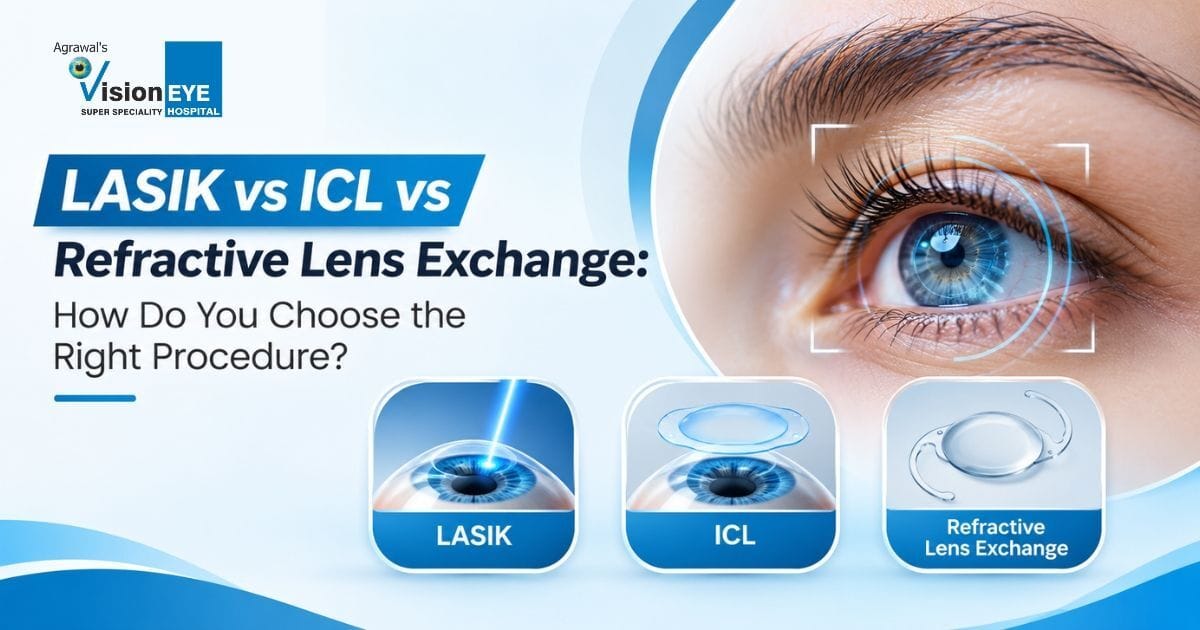
LASIK reshapes the cornea. ICL adds a thin lens inside the eye. Lens replacement swaps your natural lens for an artificial one. So the real question is which part of your eye should do the correcting, and your cornea, age and prescription answer that far better than any online ranking.
How Refractive Procedures Fix the Same Blur in Different Ways
All refractive procedures correct the same basic fault: light isn’t focusing sharply on the retina. Where they differ is the method.
The NHS explains that laser eye surgery suits most adults over 18 whose prescription has stayed roughly the same for about two years. Lens surgery, on the other hand, suits people with high prescriptions or those later in life.
That one guideline explains most clinical decisions. A stable, moderate prescription points towards laser. A strong prescription or an ageing eye points towards a lens.
LASIK vs ICL: When Your Cornea Gets the Final Say
The LASIK vs ICL decision usually comes down to one measurement: corneal thickness. LASIK removes a small amount of corneal tissue to change its shape. If your cornea is thin, or your short-sightedness is very high, there isn’t enough tissue to remove safely.
ICL avoids that problem completely. The lens sits behind the iris and in front of your natural lens, so the cornea stays untouched. It can also be taken out later if needed.
That makes ICL a strong option for younger adults with high myopia who’ve been told they aren’t suitable for laser.
Where PRK fits in
PRK is a surface laser treatment with no corneal flap. It suits some people with thinner corneas, and those in contact sports or jobs where an eye injury is more likely. The first few days are less comfortable than LASIK and healing is slower. Once settled, though, the results are comparable.
Refractive Lens Exchange: The Answer for Eyes Past Their Mid-40s
Around your mid-40s, the natural lens stiffens and reading glasses start to appear. Laser and ICL don’t fix this. Refractive lens exchange does, because it removes the ageing lens and replaces it with an artificial one, much like cataract surgery. A cataract also can’t develop in that eye afterwards.
But it isn’t right for everyone. A 2025 expert panel in CRST Today notes that the risk of retinal detachment after lens replacement rises with higher myopia, younger age and a longer eye. That’s why surgeons rarely suggest it for a short-sighted 28-year-old.
Let Your Eye Scans Make the Call, Not a Ranking
No article can measure your cornea. A proper assessment checks corneal thickness and shape, prescription stability, the depth of the front chamber, pupil size, tear film and retinal health. Those readings narrow the options quickly. Sometimes they rule one out altogether.
If you’re weighing up vision correction, a detailed assessment at Vision Eye Hospital gives you those answers before any decision is made. Dr. Shailesh Agrawal can walk you through your results and explain which of the refractive procedures suits your eyes, and why.
Book your eye assessment today and find out which option fits your vision.
FAQs :
Is ICL better than LASIK for a high prescription?
For very high short-sightedness or thin corneas, ICL is usually the safer choice because it leaves the cornea untouched. For moderate, stable prescriptions and healthy corneas, LASIK remains an excellent option. Your scan results decide which one fits you.
Can I have LASIK after the age of 45?
Yes, if your eyes are healthy. However, LASIK won’t stop the need for reading glasses, because age-related focusing loss happens in the lens, not the cornea. For many people over 45, refractive lens exchange can deal with both problems in one procedure.
Is an ICL permanent?
ICL is designed to stay in the eye long term, but it isn’t irreversible. A surgeon can remove or replace the lens if your eye changes or another treatment becomes more suitable later. You’ll still need regular eye check-ups.
How long does recovery take after each procedure?
Most LASIK patients see clearly within a day or two. ICL and lens exchange recovery is also quick, although vision can take a few weeks to settle fully. PRK takes the longest, with a few uncomfortable days while the surface heals.
What tests decide which procedure suits me?
A full assessment measures corneal thickness and shape, prescription stability, front chamber depth, pupil size, tear film quality and retinal health. Your surgeon uses these results, along with your age and lifestyle, to recommend the safest vision correction option.
