

 No Comments
If you are tired of depending on glasses, you may have come across options such as Presbyopic ICL and LASIK. Both can reduce dependence on spectacles, but they work in very different ways. Your age, prescription, corneal health and near-vision needs all matter when choosing a procedure.
Understanding the difference can help you have a more useful conversation with your eye specialist.
What Is Presbyopic ICL?
Presbyopic ICL refers to lens-based vision correction considered for people who have age-related changes in near vision along with refractive errors. An ICL is placed inside the eye while leaving the natural lens and cornea intact. Vision Eye Hospital describes ICL as a customised, biocompatible lens placed inside the eye to correct refractive errors. It can treat a wide range of myopia, hyperopia and astigmatism without removing corneal tissue.
For suitable patients, Presbyopic ICL may be discussed when laser correction is not appropriate. However, presbyopia itself needs careful assessment because not every patient will benefit from the same lens-based approach.
How Does LASIK Compare with Presbyopic ICL?
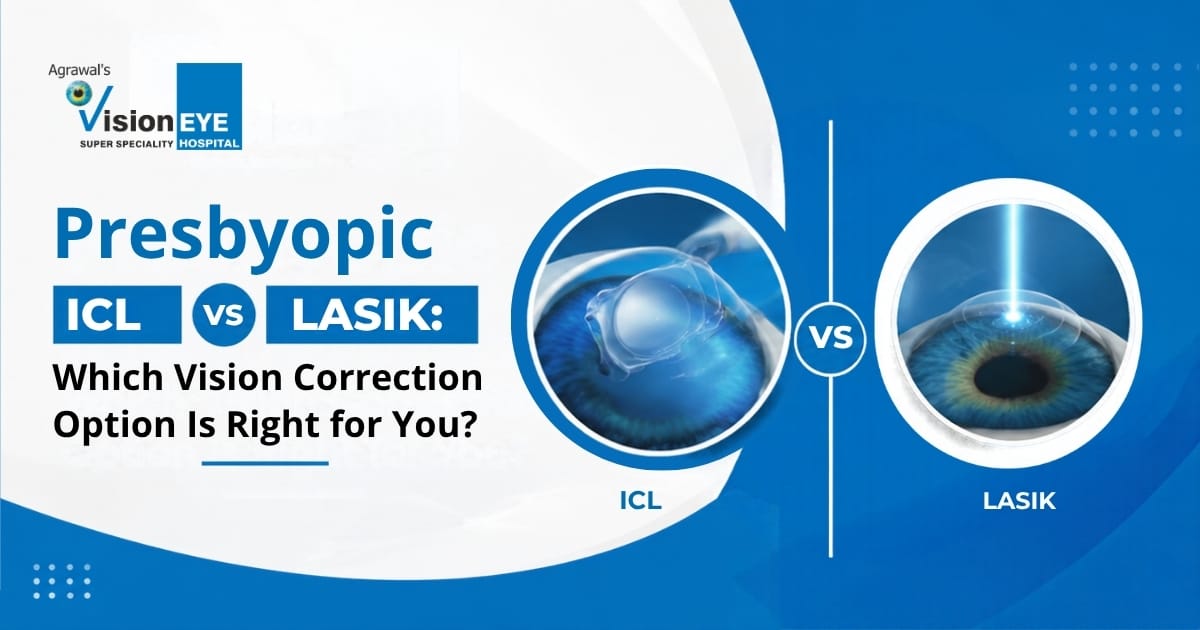
LASIK works by reshaping the cornea so that incoming light focuses more accurately on the retina. It can correct myopia, hyperopia and astigmatism in suitable adults with stable prescriptions and healthy corneas. Presbyopic ICL, on the other hand, does not reshape the cornea. The customised lens sits inside the eye and corrects the refractive error.
The key difference is simple: LASIK changes the shape of the cornea, while ICL places a lens inside the eye.
Presbyopia Treatment: Why Age Matters
Presbyopia happens naturally with age and makes close-up focusing harder. This is why choosing presbyopia treatment is not quite the same as correcting short-sightedness or astigmatism. LASIK can correct the distance prescription, but it does not stop the natural ageing process that affects near vision. Vision Eye Hospital’s LASIK information also notes that age-related presbyopia can still lead to the need for reading glasses later.
For some patients, other lens-based options may be considered as part of presbyopia treatment. The hospital’s refractive surgery information specifically discusses refractive lens exchange for people with presbyopia and high hyperopia.
When Might ICL Surgery Be Considered?
ICL surgery may be suitable for adults with high refractive errors, thin or irregular corneas, dry-eye concerns or those who are not suitable candidates for laser procedures. A detailed eye examination is needed before making that decision. One benefit of ICL surgery is that it does not remove corneal tissue. The lens is also designed to be removable if required.
The procedure uses a small incision, and the hospital states that the surgery itself generally takes around 10–15 minutes per eye, with recovery usually being quick.
What Is an Implantable Collamer Lens?
An implantable collamer lens is a foldable lens made from Collamer, a biocompatible material. It is placed inside the eye and remains there without the daily cleaning and handling required by ordinary contact lenses.
An implantable collamer lens can provide an alternative for people who cannot or do not want to undergo corneal laser correction. Its suitability depends on factors such as eye measurements, refractive error and overall eye health.
Which Option Could Be Right for You?
There is no single procedure that suits everyone.
Presbyopic ICL may be discussed when a patient has refractive errors and is not an ideal candidate for LASIK. LASIK may be suitable for adults with stable prescriptions, healthy corneas and appropriate eye measurements.
For someone primarily concerned about age-related near-vision loss, the conversation may involve other presbyopia treatment options, including lens replacement approaches.
A complete eye examination should come before choosing Presbyopic ICL, LASIK or another procedure.
What Happens Before Treatment?
Before ICL surgery or LASIK, your specialist will assess your prescription, corneal condition, eye health and other measurements. Vision Eye Hospital states that eligibility for refractive surgery depends on factors including age, eye health, prescription stability and corneal thickness.
This assessment is especially important when considering Presbyopic ICL, because the best option depends on more than your glasses prescription.
Conclusion
Choosing between Presbyopic ICL and LASIK should never be based on popularity alone. Each procedure works differently and suits different eyes and visual needs. If you need presbyopia treatment, an eye specialist can assess whether LASIK, ICL surgery, an implantable Collamer lens or a lens replacement option is more appropriate. Vision Eye Hospital by DR SHAILESH AGRAWAL provides personalised refractive care, advanced diagnostic technology and follow-up support to help patients make an informed choice.
FAQs :
1. Is Presbyopic ICL suitable for everyone with presbyopia?
No. Presbyopic ICL is not suitable for everyone. Eye health, age, refractive error, anterior chamber measurements and other factors affect eligibility. A detailed assessment helps determine whether ICL or another presbyopia treatment would better match your visual needs.
2. Is ICL surgery better than LASIK?
Neither is automatically better. ICL surgery may suit people with high prescriptions, thin corneas or unsuitable laser-surgery profiles, while LASIK can work well for selected adults. Your specialist should compare both options after examining your eyes and prescription.
3. What is an implantable collamer lens made from?
An implantable Collamer lens uses Collamer, a biocompatible material designed for placement inside the eye. The lens is customised to the patient’s eye measurements. Unlike contact lenses, it remains inside the eye and does not require daily removal or cleaning.
4. Can LASIK correct presbyopia permanently?
LASIK corrects refractive errors by reshaping the cornea, but it cannot stop the natural ageing process responsible for presbyopia. Some people may still require reading glasses later. Your specialist can discuss suitable presbyopia treatment options based on your age and vision.
5. How long does ICL surgery take?
According to Vision Eye Hospital, ICL surgery generally takes around 10–15 minutes per eye. The procedure uses a small incision and recovery is usually quick. However, individual recovery varies, so follow-up examinations and post-operative instructions remain important.
