

 No Comments
If your eye doctor has said it’s time to remove a cataract, the next question usually arrives quickly. Should you choose laser cataract surgery, or is the traditional method just as good? Many patients assume the laser does the whole job and that “laser” must mean better. Neither belief is quite true.
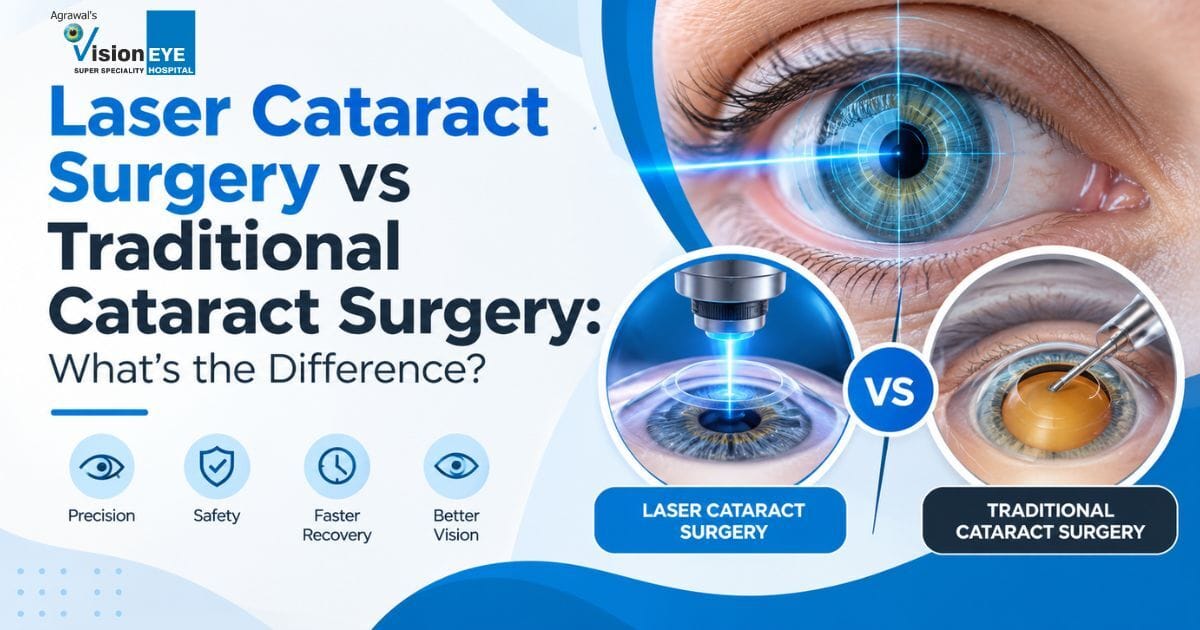
Both methods remove the cloudy natural lens and replace it with a clear artificial one. The real difference lies in how the first few steps are carried out.
Inside the Traditional Approach
The standard technique is phacoemulsification, widely known as phaco surgery. The surgeon makes a tiny incision at the edge of the cornea with a fine blade. Next, they open the thin capsule holding the lens by hand, creating a neat circular window. An ultrasound probe then breaks the cloudy lens into small pieces and gently suctions them out. A folded lens implant goes in through the same opening.
It’s quick, usually around 15 minutes, and most people go home the same day. Phaco has been refined over decades. In experienced hands, it gives excellent and predictable results.
Where Laser Cataract Surgery Takes Over
Here, a laser handles several steps that the surgeon would otherwise perform manually. It delivers ultra-short pulses of light, guided by detailed imaging of your eye.
What the Laser Actually Does
During femtosecond laser cataract surgery, the laser:
- creates the corneal incisions
- cuts the circular opening in the lens capsule
- softens and divides the cataract into segments
- adds small relaxing incisions to reduce mild astigmatism, if needed
After that, the procedure continues much like phaco. An ultrasound probe still removes the softened fragments, although it needs less energy to do so. The same range of lens implants is used in both methods.
Precision Versus Proof: Is the Laser Really Better?
This is where expectations and evidence part ways. Laser-assisted cataract surgery produces very precise, consistent capsule openings and reduces the ultrasound energy used inside the eye. That sounds like a clear win.
But large randomised trials in the UK and France found that patients had similar vision and similar safety outcomes with either approach.
The laser also adds cost, and it isn’t suitable for every eye. A pupil that doesn’t dilate well, scarring on the cornea or difficulty lying flat and still can rule it out.
So, the honest answer? The laser helps in specific situations, such as some very dense cataracts or eyes that need astigmatism correction at the same time. For most routine cataracts, a skilled surgeon performing phaco achieves comparable results.
Your Eyes Deserve a Plan, Not a Label
The right technique isn’t decided by a brochure. It depends on how dense your cataract is, the shape of your cornea, the lens you choose and what you expect from life after surgery. Whether you’re weighing up laser cataract surgery or a traditional procedure, your surgeon’s experience and careful measurements matter far more than the name of the method.
At Vision Eye Hospital in Surat, Dr. Shailesh Agrawal and his team start with a thorough eye examination before recommending any procedure. You’ll leave knowing exactly what your cataract needs and which lens suits your daily routine.
Book a cataract consultation at our Parle Point, Parvat Patia or Vesu branch, and get a treatment plan built around your eyes.
FAQs :
1. Is laser cataract surgery completely blade-free?
Not entirely. The laser creates the incisions and the capsule opening, but an ultrasound probe still removes the lens fragments, and fine instruments then place the new implant. “Blade-free” describes the incisions, not the whole procedure from start to finish.
2. Does the laser give better vision than phaco?
For most patients, studies have found no meaningful difference. Large clinical trials reported similar visual results and safety for both surgical methods. Your final vision depends more on accurate measurements, the lens implant chosen and the surgeon’s skill and experience.
3. Is recovery faster after a laser procedure?
Recovery is broadly similar. Most people notice clearer vision within a few days with either method, while full healing takes a few weeks. You’ll use prescribed eye drops and avoid heavy lifting, dust and water splashes in the first week.
4. Can I choose a premium lens with traditional surgery?
Yes. Monofocal, toric and multifocal lenses can be implanted with traditional phaco as well as laser techniques. Your lens choice is a separate decision, based on your eye measurements, any astigmatism and how much you want to rely on glasses.
5. How do I know which cataract surgery suits me?
A detailed eye examination answers this. At Vision Eye Hospital, Dr. Shailesh Agrawal reviews your cataract density, corneal health and visual goals, then explains the most suitable approach. You can book an appointment at any of our three Surat branches.
