

 No Comments
Years of glasses or contact lenses tend to make people wonder, eventually, what life would look like without them. No fumbling for spectacles first thing in the morning. Just. clarity, straight away. It’s an appealing thought, and it’s a big part of why Refractive Procedures have caught on so widely – they give people a real, lasting way to cut down or drop their dependence on corrective eyewear altogether.
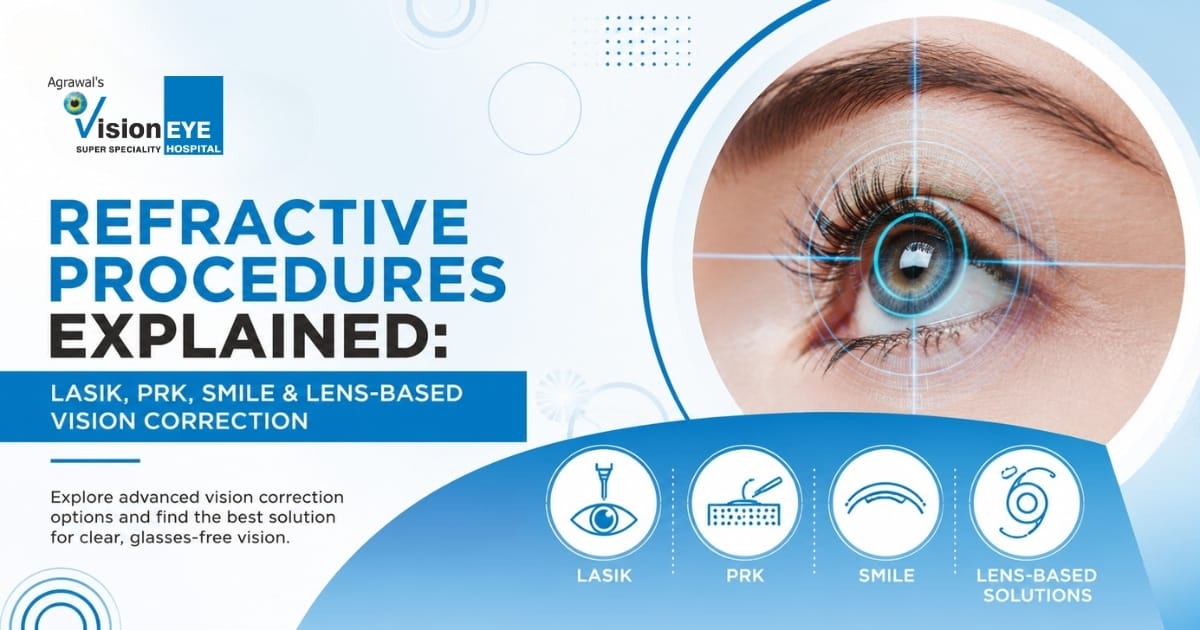
But here’s something worth knowing upfront: there’s no single procedure that fits everyone. LASIK(Laser-Assisted In Situ Keratomileusis), PRK(Photorefractive Keratectomy), SMILE(Small Incision Lenticule Extraction), and lens-based vision correction surgery work in their own way, suited to different patients for different reasons. Which one’s right for you comes down to your eye health, your lifestyle, your prescription, and a handful of clinical details that only a proper eye exam can pin down.
Understanding Refractive Procedures
These aren’t off-the-shelf fixes. Every refractive procedure is essentially customised, built around what a specific pair of eyes needs. The underlying goal is simple enough – reshape or replace part of the eye’s focusing system so light lands where it should, on the retina, producing clearer vision. How that happens, though, depends entirely on the eyes in question.
Experienced ophthalmologists will spend real time checking corneal thickness, eye power, tear film quality, and general eye health before suggesting anything. It’s that groundwork – the thorough assessment – that actually determines what’s safest and most effective for each patient.
LASIK – The Most Familiar Option
Most people have at least heard of LASIK. The procedure creates a thin corneal flap, then a laser reshapes the tissue underneath. Recovery is typically fast; plenty of patients see a marked improvement within a day or two.
It isn’t for everyone, though. Thin corneas, unstable prescriptions, certain eye conditions – any of these might steer a surgeon toward a different option instead. So a proper consultation counts for a lot more than simply picking the procedure everyone’s heard of.
LASIK vs PRK – What's the Difference?
People often ask about LASIK vs PRK. Both rely on laser technology to fix refractive errors, but they get to the cornea differently.
LASIK works through a corneal flap. PRK skips the flap and removes the outer surface layer instead, reshaping the cornea from there. Because there’s no flap involved, PRK often suits patients with thinner corneas, or anyone in contact sports where a knock to the eye is a real possibility. Healing generally takes a bit longer with PRK, though the long-term results tend to hold up just as well for the right candidates.
Why More Patients Are Choosing SMILE Surgery
SMILE surgery is one of the newer techniques in laser vision correction, and it’s picked up real momentum over the past few years. No flap here either – the surgeon takes out a small piece of corneal tissue through a tiny incision instead. Done minimally invasively like this, it can leave more of the cornea’s natural strength intact and ease some of the discomfort patients feel afterwards.
Eligibility still comes down to testing, not preference, same as any refractive procedure. The technology keeps getting better, sure, but picking the right patient still matters more than the tech itself when it comes to good outcomes.
What About Lens-Based Vision Correction?
Laser isn’t the answer for everyone. Very high spectacle numbers, age-related changes, early lens problems – these patients often do better with lens-based vision correction.
Instead of reshaping the cornea, this method replaces or adds to the eye’s own natural lens. For anyone who doesn’t qualify for laser treatment, it’s a solid alternative. And working out which path makes sense – laser or lens – starts with understanding your own eyes, not with following whatever’s popular right now.
Why Personalised Evaluation Matters
A lot of people go online looking for “the best” procedure. But the best procedure, really, is just whichever one suits your eyes. At Vision Eye Hospital, treatment recommendations come from comprehensive diagnostic testing and a patient’s actual lifestyle, not a fixed template applied to everyone.
Dr Shailesh Agrawal brings modern diagnostics and genuinely individual care to each evaluation before deciding what’s most suitable.
Final Thoughts
Life without glasses has become real for a lot of people thanks to modern refractive procedures. But picking the right one takes more than skimming recovery timelines or online reviews.
LASIK, PRK, SMILE, lens-based correction – whichever it turns out to be, it should follow a proper eye assessment. At Vision Eye Hospital, patients are monitored and guided by Dr Shailesh Agrawal for expert recommendations on eye health, lifestyle, and long-term vision goals.
FAQs :
1. Which one is better: LASIK vs PRK?
Neither wins outright – it depends on the patient. LASIK vs PRK comes down to corneal thickness, eye health, lifestyle, and how stable the prescription is. A detailed eye exam is what actually settles which option is safest long-term.
2. Is SMILE surgery painful?
Barely, if at all – the eye’s numbed with anaesthetic drops first. There might be some mild irritation afterwards for a short stretch, but recovery is usually easy, and most people are back to normal within a few days.
3. Who is a suitable candidate for vision correction surgery?
Typically, adults with a stable prescription, healthy eyes, and expectations that match reality. Corneal thickness, overall eye condition, and lifestyle all factor in too – which is why a full assessment always comes before any decision.
4. How long does it take to recover after refractive eye treatment?
Depends entirely on the procedure. Some patients have clear vision within a day; others need weeks to fully heal. Following the post-op instructions and turning up to follow-ups makes a real difference to how smoothly that goes.
5. Can refractive procedures permanently remove the need for glasses?
For many, yes, largely – but not universally. Ageing and natural changes in the eyes over time can still bring back the need for glasses occasionally, particularly for reading or close-up work later on.
