

 No Comments
Ask a room of glasses wearers how they’d fix their eyesight and most will name the same laser treatment. It’s a fair starting point. But it’s only one of several refractive procedures, and the right choice depends less on what’s popular than on your cornea, your prescription and the way you live.
Here’s what each option changes inside the eye, and why two people with the same prescription can get very different recommendations.
What Refractive Procedures Actually Fix
A refractive error means light isn’t landing precisely on the retina. Short-sightedness, long-sightedness and astigmatism are the most common types. Glasses bend light before it enters the eye. Refractive procedures do the same job permanently, either by reshaping the cornea or by placing a corrective lens inside the eye.
That split matters. Corneal treatments remove a tiny amount of tissue, so they need enough of it to begin with. Lens-based treatments leave the cornea untouched.
The Laser Family: Reshaping the Cornea
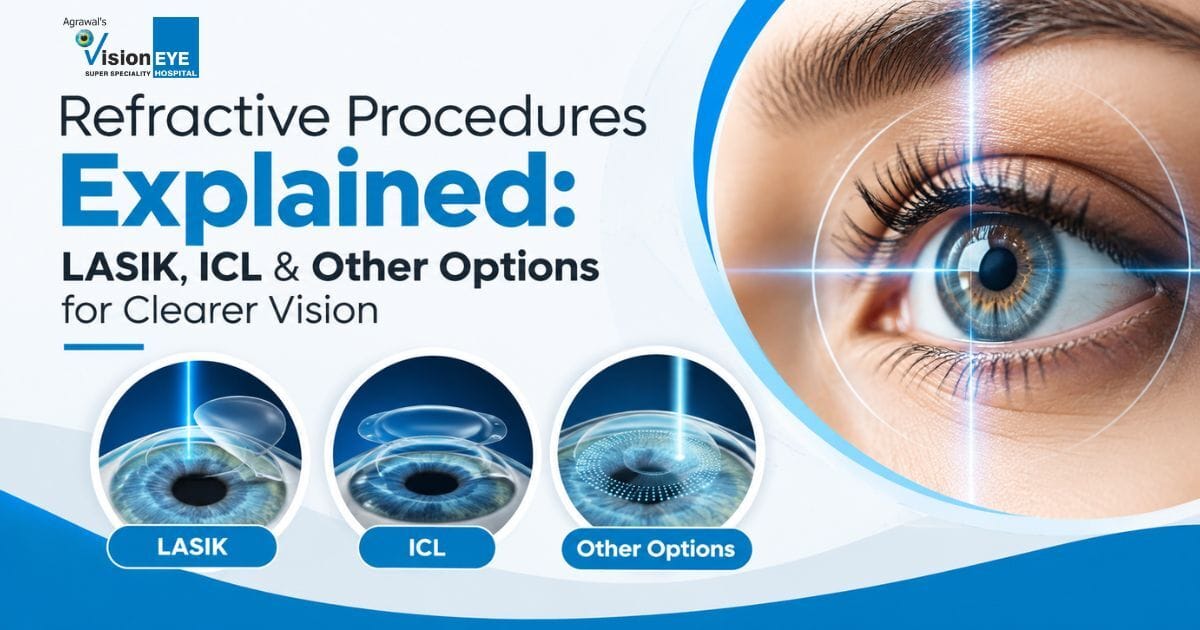
LASIK is the name most people know. The surgeon creates a thin flap on the corneal surface, reshapes the tissue beneath with an excimer laser, then lays the flap back in place. It takes minutes per eye.
It isn’t the only laser route, though:
- SMILE (small incision lenticule extraction): a small disc of tissue is removed through a keyhole opening, with no flap.
- PRK and LASEK: the outer surface layer is removed or loosened before reshaping. Healing is slower, but these suit thinner corneas.
Recovery is a big part of the appeal. After LASIK, most people see clearly within a day or two, though swimming and contact sports wait a little longer.
When the Cornea Says No: The Case for ICL
Some eyes aren’t suited to laser reshaping. Very high prescriptions, thin corneas and early corneal weakening can all rule it out.
That’s where an ICL (implantable contact lens) comes in. Instead of removing tissue, the surgeon places a thin, flexible lens inside the eye, behind the iris and in front of your natural lens. Think of it as a contact lens you never touch. And because the cornea stays intact, the lens can be removed later if needed.
Over 40? Why Lens Exchange Enters the Picture
Refractive lens exchange replaces the eye’s natural lens with an artificial one, much like cataract surgery carried out before a cataract forms. It suits older patients whose near focus is fading, along with people who have high long-sightedness.
Why Two Identical Prescriptions Get Different Answers
A thorough assessment before refractive eye surgery looks well beyond your spectacle number. Corneal mapping shows shape and thickness in fine detail. Tear tests check for dry eye, which laser treatment can aggravate. Eye pressure and retinal health are checked too.
Your prescription also needs to have held steady for at least a year. That’s why surgeons don’t treat anyone under 18, and why contact lens wearers pause before measurements, since lenses temporarily alter the cornea’s shape.
Put together, these results narrow the list of suitable refractive procedures for your eyes, sometimes down to one clear option.
Lifestyle counts too. A footballer, a night-shift driver and someone at a screen all day will each weigh the trade-offs of vision correction differently.
Inside a Consultation at Vision Eye Hospital
Vision Eye Hospital has provided eye care in Surat since 2011, with branches at Parle Point, Parvat Patia and Vesu. Its team works across laser treatments, lens exchange and implantable lenses, so a recommendation is never tied to a single machine.
The hospital was founded by Dr. Shailesh Agrawal, an M.S. (Ophthalmology) gold medallist. The approach is simple: explain what the tests show, lay out the options that fit, and say so honestly when the better answer is to wait.
Glasses Off or Not, Start With the Right Questions
The best of the refractive procedures isn’t the newest or the most advertised. It’s the one your cornea, prescription and daily routine can support.
If you’re in Surat and weighing up vision correction, book an assessment at Vision Eye Hospital. You’ll leave knowing which options suit your eyes, and why.
FAQs :
Are refractive procedures permanent?
The correction itself is permanent, as laser treatment reshapes the cornea and implanted lenses stay in place. Your eyes still age, though. Reading glasses usually become necessary after 40, and cataracts can still develop independently of the original surgery later.
Is LASIK painful?
Numbing drops are used, so the procedure itself isn’t painful. Most people feel brief pressure for a few seconds. Afterwards, the eyes can feel gritty, watery or sensitive to light for a day or so, which settles with prescribed drops.
Who should consider ICL instead of laser treatment?
An implantable lens suits people with high short-sightedness, thin corneas or dry eyes that rule out laser reshaping. Because no corneal tissue is removed, it keeps future options open. A detailed assessment confirms whether your eye has room for it.
How long does recovery take after refractive eye surgery?
It depends on the procedure. Flap-based laser treatment and SMILE usually allow a return to desk work within a few days. Surface treatments like PRK take about a week to settle, and full visual stability can take several more weeks.
How do I know which vision correction option is right for me?
Only a full eye assessment can tell you. Corneal mapping, thickness measurements, tear tests and a stable prescription history all shape the final recommendation. At Vision Eye Hospital in Surat, the team explains every result before suggesting a suitable route.
